
Many people think that mining Bitcoin is “making magic money.” In reality, it's something else entirely: it's what makes the heart of the Bitcoin network beat.
What is mining?
Mining Bitcoin does not mean “creating” bitcoins out of thin air. It involves validating network transactions, grouping them into blocks and then adding them to the blockchain (Bitcoin's public and unchangeable ledger).
To accomplish this, miners use specialized machines (called ASICs) that can solve a complex mathematical problem, which involves finding a valid hash. The first to find this code adds a new block to the chain and receives a reward: newly issued bitcoins, along with the associated transaction fees.
⏳ Halving: why the reward for minors is decreasing
When a miner adds a new block to the blockchain, they receive a Bitcoin reward. But this award is not Not fixed : she Decreases by half every four years approximately. That's what we call the Halving (or “division by two”).
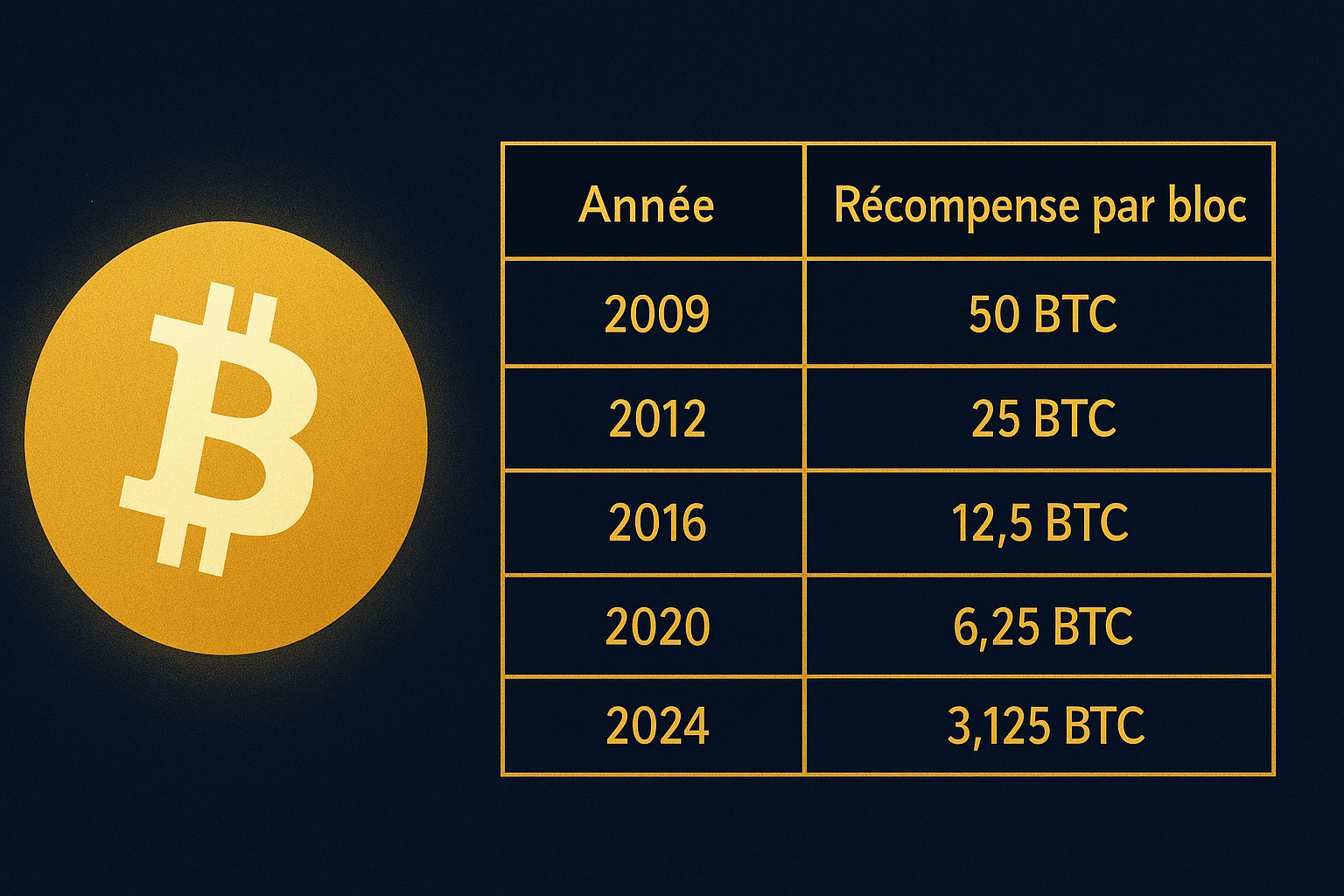
This gradual decrease is provided from the start in the Bitcoin code. It will continue until 2140, date on which The last bitcoin will be created. From that point on, miners will no longer receive new bitcoins, but will only live on transaction fees paid by users.
Halving is used to control the offer :
It makes it possible to create new bitcoins predictable, limited and transparent. Unlike conventional currencies, where central banks can create money at will, Bitcoin follows a unchangeable rule : there will be no Never more than 21 million bitcoins.
It is this mechanism that makes Bitcoin a rare currency, non-inflationary and incorruptible by design.
Why is mining essential?
Mining is not a technical detail. It is a fundamental pillar of the Bitcoin protocol, which provides three vital functions:
- Securing the network : Any attack would require a colossal expenditure of energy, making piracy economically impossible.
- Ensuring decentralization : Thousands of minors participate freely in the process, without leadership or central authorization.
- Issuing new bitcoins : It is the only way to create them, according to a predictable and limited schedule until 2140.
In other words: without mining, no Bitcoin.
⚡ And the energy in all of this?
Yes, mining consumes energy. But contrary to some preconceived ideas, it is not a waste: it is a voluntary expenditure of energy to secure a global monetary system.
“Bitcoin isn't wasting energy, it's monetizing it.” — Saifedean Ammous
Bitcoin is turning energy into enduring value. Moreover, a growing part of mining is fuelled by renewable or surplus sources, often in areas where this energy would otherwise be lost (isolated hydroelectric power plants, solar or wind surplus).
According to the Cambridge Digital Mining Industry Report ofthe Cambridge Centre for Alternative Finance (CCAF), published in 2025, 52.4% of the energy consumed by Bitcoin mining now comes from sustainable sources, including 42.6% renewable energies (hydro, wind, solar) and 9.8% of nuclear energy, against 37.6% in 2022.
This progress shows that the mining sector is gradually adopting a low carbon energy mix, in parallel with a sharp decrease in coal (8.9% of energy intake), while natural gas is becoming the main fossil source with 38.2%.
An emblematic example is that of Virunga National Park, in the Democratic Republic of Congo, where Bitcoin mining revenues fund electricity production 100% hydroelectric. This model allows both to secure the park, of create local jobs And ofelectrifying villages surroundings.
Au bhutan, the government is exploiting its hydroelectric surpluses to mine Bitcoin, turning this excess energy into national currency reserves.
And at salvador, part of the mining is powered by thegeothermal energy From volcanoes — the project Volcano Energy symbolizes this alliance between energy innovation and monetary sovereignty.
Integrating these examples, the statement that Bitcoin turns energy into value is not a metaphor: it is based on facts.
Mining valorize surpluses, Integrate renewables, and stimulates local investment where energy was once underused.
Bitcoin thus becomes a energy optimization tool : it captures losses, valorizes surpluses and contributes to the transition to a more efficient and sustainable economy.
🐄 Mining and the reduction of methane: transforming waste into a resource
The methane (CH4) Is a greenhouse gas 84 times more polluting than CO₂ over twenty years.
It is emitted naturally by livestock farms, the landfills And the oil sites when some of the gas escapes or is burned (Flaring).
Mining companies like Crusoe Energy (United States) or Vespene Energy (California) are now installing their machines directly on these sites to use methane instead of letting it escape into the atmosphere.
Result:
- Methane is converted to electricity for mining,
- global greenhouse gas emissions are drastically reduced,
- and the methane producing site generates a new source of revenue.
According to the climate investor Daniel Batten, these methane-fuelled mining projects could reduce global CH4 emissions by up to 8% if deployed on a large scale.
In other words, Mining can transform one of the most polluting gases on the planet into useful and clean energy, while securing Bitcoin.
🌡️ Mining and heat recovery: nothing is lost
Mining Bitcoin consumes energy... but Nothing is lost. In reality, almost all of the electricity used is converted to heat. And that heat can be recovered and reused in many contexts.
🔁 Turning an expense into a resource
Miners are increasingly installing their machines in environments where The heat produced is used to heat :
- Of residential buildings or municipal swimming pools,
- Of agricultural greenhouses,
- Of fish farms,
- or even district heating networks.
Thus, mining can become a doubly useful activity : securing the Bitcoin network and heating local infrastructures.
🌍 Concrete examples
- In Switzerland, mining farms heat greenhouses for the production of off-season vegetables.
- In Canada, some public pools use the heat from ASICs to keep the water at a constant temperature.
- In the Netherlands, Miners' heat heats tulip greenhouses, reducing gas consumption.
In these models, The energy cost of mining is falling sharply, because the energy spent to produce Bitcoin supersedes another heating source that would have consumed gas or fuel oil.
💡 A circular vision of energy
Mining then becomes a energy efficiency tool : it allows you to Convert electricity into monetary security, while valorizing residual heat for other useful uses.
In other words, Bitcoin can heat your home, pool, or farm while securing the most robust network in the world.
🧭 In summary
Mining is the Bitcoin backbone. It turns energy into security, competition into truth, and electricity into monetary freedom.
No mining, no blocks.
Without blocks, there is no network.
Without a network, there is no Bitcoin.
But beyond technology, mining reveals a deeper truth: Bitcoin is not a waste of energy, it is a energy and ecological revolution in the making. It valorizes surpluses, reduces methane, integrates renewable energies, and transforms thermal waste into useful heat.
More and more experts, such as Daniel Batten, underline:
“Bitcoin is the best ESG asset in the world.”
(Source: X/Twitter, November 16, 2023)
Bitcoin proves that a monetary system can be both decentralized, sustainable and efficient. It is a technology that Energy, finance and environment unit and that offers the world a solid, transparent and responsible alternative.
Our Blog
Discover our educational articles, practical guidance, and crypto news to help you better understand, secure, and grow your digital assets.
María Corina Machado: a Nobel Peace Prize winner who believes in Bitcoin
María Corina Machado, Nobel Peace Prize 2025, sees Bitcoin as a tool for freedom and resistance in the face of censorship and economic oppression.
Securing your bitcoins: understand, choose, protect
Buy, secure, transmit your cryptos without stress. NovCoin guides you step by step to understand Bitcoin and take control of your digital assets with clarity, security and confidence.
Virunga: when hydropower and Bitcoin support biodiversity
At Virunga Park, hydroelectricity powers a Bitcoin farm whose revenues fund conservation, rangers and local projects, proving the ecological and sovereign impact of responsible mining.
The Bitcoin Whitepaper: Simply Understanding Bitcoin's Foundational Text
Published in 2008 by Satoshi Nakamoto, the Bitcoin Whitepaper presents a decentralized digital currency that allows direct payments between peers without intermediaries, secured by cryptography.

Bitcoin lexicon
This lexicon helps you to simply grasp the key concepts of Bitcoin and its ecosystem, without jargon or complexity.

From concrete to Bitcoin: the new safe haven asset
Bitcoin, an alternative to real estate as a store of value? Learn how it is redefining capital and giving hope to new generations.
Businesses: what if part of your cash was in Bitcoin?
Businesses: diversify your cash flow with Bitcoin. NovCoin supports you for a secure, structured investment that is in line with your objectives.

You bought Bitcoin. And now?
Did you buy Bitcoin? NovCoin helps you secure your BTC with a personal wallet that is simple, reliable and free of technical jargon.

A heritage apart — a heritage at risk
What will happen to your bitcoins in the event of your death? NovCoin helps you plan a transmission that is secure, discreet and in accordance with your wishes.
Merchants: understanding and adopting Bitcoin payments
NovCoin helps Belgian retailers reduce fees and attract new customers.